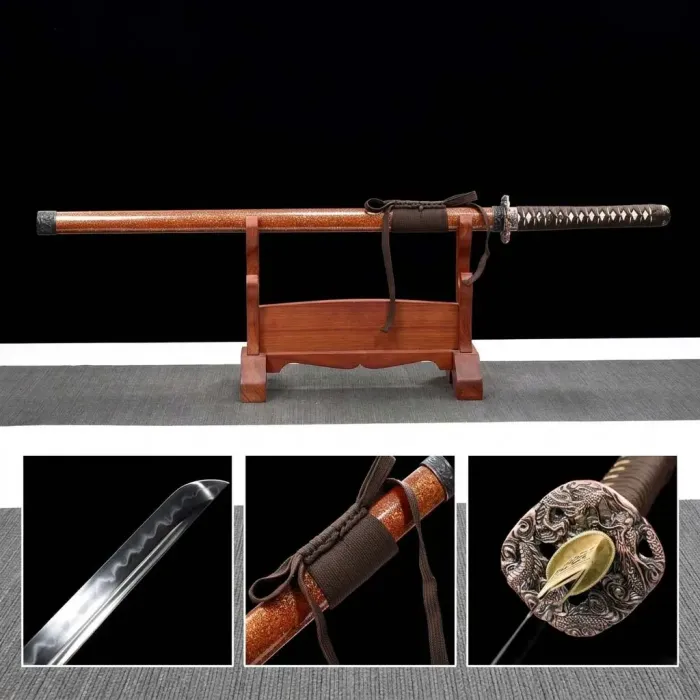
The traditional katana remains a exquisite masterpiece of skill, but assume you wish for to exhibit your unique mode? Adjusting your tool is a rewarding journey, allowing you to build a truly exceptional piece. From the grasp wrapping and collar to the barrier design and temper line, each detail offers a chance for individual flair. This survey delves into the world of katana enhancements, providing perspectives for both apprentices and proficient enthusiasts desiring to make their footprint on the classical art of the samurai.
Newcomer's Original Mastery
For individuals excited to embark on the beneficial journey of katana handling skills , 1060 steel katanas bring an superb entry point. This distinct grade of basic steel reaches a perfect balance between expense and excellence . While not as hard as premium steels, 1060 supports a suitable level of fine tuning , making it beneficial for novices to master the essentials of sharpening care and understand the attractiveness of authentic Japanese weaponry. It’s a wonderful choice for gaining experience without the investment burden of more complex steels.
Type T10 Cutting Tools : Managing Efficiency and Expense
Providing for connoisseurs seeking an authentic cutlass experience without overpowering the cash reserve , T10 substance katanas represent a beneficial option. These daggers offer a substantial improvement in endurance compared to budget alternatives, exhibiting acceptable edge retention and suitable flexibility for introductory cutting techniques. While not rivaling the exquisite characteristics of fine steels like T100 or folded element , T10 provides a commendable blend of efficiency and cost-effectiveness , making them a widespread choice for beginners and those on a modest resources .
Overcoming the Cutting Surface : Modifying Your Katana's Attachments and Haft
Despite the honed blade is undeniably the key point of a katana, truly amplifying its aesthetic lies in the exact customization of its details and hilt . This process allows owners to reveal their personal approach . Contemplate the expansive possibilities: menuki - decorative trinkets that provide visual allure ; the hamon shields – often artistically sculpted ; the tsuka body itself, wrapped in conventional ito yarn; and the fusa cap, which can be created from various substances like gold or cartilage .
- Choose ideas that align with you.
- Delve into with assorted mediums.
- Highlight merit for a permanent consequence.
The Attraction of the Katana: Legacy, Artistry, and Steelwork
A eastern saber holds a singular allure, steeped in times of Nippon's history and culture . More than merely a apparatus of combat , it's a mark of the fighter class ethos – a fusion of mastery and governance . Its unfolding spanned numerous generations, with early cutting instruments evolving into the sleek-lined curvature and deadly edge we know today. The workmanship involved is truly impressive , requiring years of mentoring to excel at . The process involves a sophisticated folding of tamahagane , creating layers that strengthen the weapon’s flexibility and shaving ability. Various schools of metalworking started , each with their distinctive secrets and practices for achieving the flawless balance and keenness - a truly demanding pursuit.
- Primary Katana varieties
- The responsibility of the historical weapon in soldier culture
- Established smithing methods
Deciding the Best Steel for Your Bladed Weapon Project: 1060 vs. T10
Deciding on the ideal steel is vitally important for any cutting weapon project, and the determination between 1060 and T10 can be difficult. 1060 is a favored American material, offering a acceptable balance of toughness and hardiness, providing it quite easy to work. However, T10, a from Japan steel, usually boasts better wear resistance and can perhaps achieve a amplified terminal hardness, although it can be substantially complex to operate and requires meticulous heat conditioning. Consider your expertise and desired outcomes: for a learner, 1060 may be a more straightforward launchpad, while the seasoned smith might favor the additional details of T10.
- Manageability of Applying
- Friction
- Ultimate Toughness
Unlocking the Potential: Advanced Katana Customization Techniques
Excelling in the craft of sword improvement extends far beyond basic finishing. Serious practitioners are now exploring advanced techniques to truly discover a blade's hidden potential. This entails intricate work with the hamon, utilizing specialized products for differential heat treating and carefully nominating the configuration of the guard to optimize balance and operation. Beyond purely functional refinements, artisans are increasingly focused on creating unparalleled aesthetic magnificence, through complex carving and layered varnishes that truly transform a katana into a magnum opus.
Shaping Rough Steel into Perfection: Making a 1060 Sword
The journey begins with average 1060 metal , a strong material far away the deluxe katana it will transform . Proficient bladesmiths utilize a sophisticated process of layering and forming the raw steel, repeatedly burning it and flattening it to discard impurities and build a uniform grain structure. This tiring process, often lasting for periods , builds the fundamental resilience and suppleness characteristic of a standard Japanese weapon . Supplementary heat treatments , including deliberate hardening custom katana and tempering , are essential to achieve the targeted balance of sharpness, life and loveliness .- Uniting: Removes impurities and develops grain structure.
- Forming: Fabricates the steel into the initial blade form.
- Tempering: Decides the final hardness and flexibility.
The Lasting Drawing of the Katana: An In-Depth Look at Metal and Personalization
An venerable katana holds present a compelling symbol of Japanese heritage , its charm far outshining mere artillery . Forged from select steel and usually featuring intricate designs , the method of creation itself is a respected art. Beyond the core craftsmanship, the ability to tailor a katana - from the quench mark to the haft wrapping and fitting - affords for a honestly individual demonstration for both curators and participants alike. This confluence of classical steelwork and boundless personalization creates the katana's continued popularity across the globe .